
Working as a gig worker or freelancer gives you flexibility, but it also means you’re responsible for paying your own taxes. If those taxes pile up, an offer in compromise gig workers 1099 option may allow you to settle your IRS debt for less than the full amount. For many taxpayers, it can be an effective freelancer IRS debt settlement solution.
This guide explains how a 1099 worker OIC is evaluated, what the IRS checks, and how gig income is reviewed during the process. It also covers how an IRS offer in compromise for self-employed taxpayers works, when you may qualify for gig economy tax debt relief, and what self-employed IRS settlement debt options are available if you don’t qualify.
| Key Takeaways • Gig workers and 1099 contractors may qualify for an IRS Offer in Compromise (OIC) if they cannot reasonably pay their full tax debt based on their income, expenses, assets, and future earning potential. • The IRS carefully reviews self-employed taxpayers’ financial records, including business income, expenses, bank statements, and supporting documentation, before approving an Offer in Compromise. • To be eligible for an OIC, you must be tax compliant, including filing all required tax returns, staying current on estimated tax payments, and submitting complete financial information. • If an Offer in Compromise isn’t available, other IRS relief options such as an Installment Agreement, Currently Not Collectible (CNC) status, or First-Time Penalty Abatement may help you manage your tax debt. • Accurate documentation and professional tax representation can improve your chances of success, helping you avoid application mistakes, negotiate with the IRS, and choose the most effective tax debt resolution strategy. |
Why Gig Workers and 1099 Contractors Often Owe the IRS
An offer in compromise gig workers 1099 case usually doesn’t begin with one big mistake. Instead, many gig workers and 1099 contractors gradually build up IRS tax debt over several years by missing estimated tax payments, failing to set aside enough money for taxes, or underestimating how much they owe.
Self-Employment Taxes and Estimated Tax Payments
Independent contractors must pay both income tax and the full 15.3% self-employment tax because no employer withholds taxes or pays part of it. If you miss quarterly estimated tax payments, you could face a large tax bill at filing time. Over time, this can lead to IRS debt and may make an offer in compromise for gig workers on a 1099 a possible option to resolve what you owe.
Common Reasons Freelancers Fall Behind on Taxes
Understanding why tax debt happens is the first step. Next, let’s look at how the IRS decides whether you qualify for an Offer in Compromise.
- Income changes from month to month, making it hard to budget for taxes.
- No employer withholds taxes from your payments.
- Business expenses are not tracked properly, increasing taxable income.
- Earnings from multiple 1099 forms can make tax reporting more complicated.
- Many people delay seeking IRS debt settlement with a freelancer, causing the tax debt to grow with penalties and interest.
How IRS Debt Grows with Penalties and Interest
If you don’t pay your taxes on time, the IRS adds failure-to-pay penalties, failure-to-file penalties, and interest to your balance. These charges continue to grow until the debt is paid, making it more expensive over time. That’s why it’s important to act early if you’re considering an offer in compromise for gig workers 1099 to settle your IRS debt.
What Is an IRS Offer in Compromise?
An Offer in Compromise (OIC) is an IRS program that allows eligible taxpayers to settle their federal tax debt for less than the full amount owed. The IRS approves an offer only if it believes you cannot realistically pay the full balance based on your financial situation.
How an Offer in Compromise Works
The IRS may accept an Offer in Compromise if it believes you cannot afford to pay your full tax debt. To decide, the IRS reviews your income, expenses, assets, and ability to pay in the future. This is especially important for gig workers with 1099 income because their earnings often change from month to month.
Eligibility Requirements for Self-Employed Taxpayers
To qualify for a self-employed IRS settlement debt option through an Offer in Compromise, you must meet these basic IRS requirements:
- File all required tax returns.
- Not be involved in an active bankruptcy case.
- Be current on this year’s estimated tax payments.
- If you have employees, stay current on all required federal payroll tax deposits for the current and previous two quarters.
Types of OIC Programs Offered by the IRS
An offer in compromise gig workers 1099 case generally falls into one of three categories:
| OIC Basis | When It Applies |
| Doubt as to Collectibility | You don’t have enough assets or income to pay the full balance |
| Doubt as to Liability | There’s a genuine dispute about whether the tax is actually owed |
| Effective Tax Administration | You could technically pay, but doing so would create economic hardship |
Can Gig Workers Qualify for an Offer in Compromise?
Yes. Gig workers may qualify for gig economy tax debt relief through an Offer in Compromise, but the IRS often reviews self-employed applications more closely than those of W-2 employees. In a gig worker’s 1099 case, the IRS carefully checks your income, expenses, business records, and financial documents before deciding whether to accept your offer.
IRS Financial Analysis for Freelancers
For a freelancer IRS debt settlement, the IRS takes a close look at your financial records. Since gig income often changes from month to month and comes from multiple platforms, you may need to provide earnings statements, business bank records, mileage logs, and other expense records. The IRS compares these documents with your Schedule C to verify your income and business expenses.
Income, Expenses, and Asset Evaluation
The IRS reviews your income, monthly living expenses, and assets to determine how much you can realistically pay. It uses its Collection Financial Standards to decide which expenses are allowed and also considers the value of business assets, such as a vehicle, equipment, or home office items, when evaluating your ability to pay.
When OIC Is More Likely to Be Approved
A 1099 worker OIC is more likely to be approved if your income has decreased, your expenses are well documented, and you have few assets. You must also be up to date with all required tax returns and current tax payments. A strong gig economy tax debt relief case is supported by accurate financial records, not just a low income.
Steps to Apply for an Offer in Compromise
Once you meet the IRS eligibility requirements, the self-employed IRS settle debt application follows the same basic process for all taxpayers, including gig workers and 1099 contractors.
File All Required Tax Returns First
Before applying, you must file all required tax returns. The IRS will not review your Offer in Compromise application until you are up to date with your tax filing requirements.
Complete IRS Form 656 and Form 433-A (OIC)
To apply, complete IRS Form 656, which contains your settlement offer, and Form 433-A (OIC), which provides details about your income, expenses, assets, and debts. Most applicants must also pay a $205 application fee, although the fee is waived for those who qualify under the IRS Low-Income Certification.
Submit Supporting Financial Documentation
Include documents that support the information in your application, such as bank statements, profit and loss records, loan statements, and proof of income. For an IRS offer in compromise for a self-employed application, the IRS checks these records carefully, so missing or inconsistent information can delay or even result in a rejection.
Alternatives If You Don’t Qualify for an Offer in Compromise
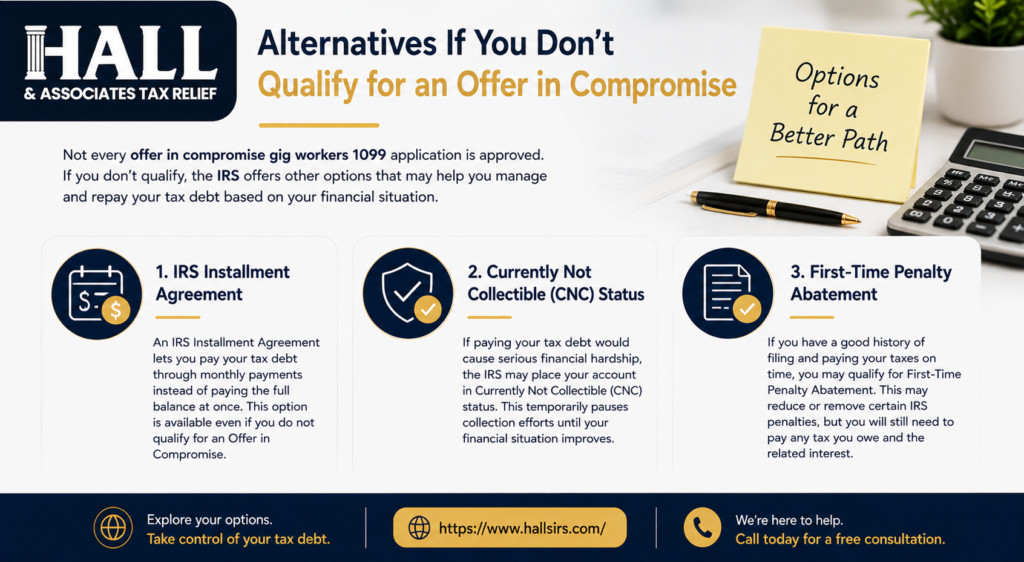
Not every offer in compromise for gig workers’ 1099 application is approved. If you don’t qualify, the IRS offers other options that may help you manage and repay your tax debt based on your financial situation.
IRS Installment Agreement
An IRS Installment Agreement lets you pay your tax debt through monthly payments instead of paying the full balance at once. This option is available even if you do not qualify for an Offer in Compromise.
Currently Not Collectible (CNC) Status
If paying your tax debt would cause serious financial hardship, the IRS may place your account in Currently Not Collectible (CNC) status. This temporarily pauses collection efforts until your financial situation improves.
First-Time Penalty Abatement
If you have a good history of filing and paying your taxes on time, you may qualify for First-Time Penalty Abatement. This may reduce or remove certain IRS penalties, but you will still need to pay any tax you owe and the related interest.
Mistakes That Can Cause an OIC Rejection
Many Offer in Compromise applications are denied because of mistakes that could have been avoided. In an offer in compromise gig workers 1099 case, the IRS carefully reviews your financial information, so accuracy and complete documentation are essential.
Incomplete Financial Information
Missing bank statements, unreported income, or incomplete expense records can delay your application or lead to a denial.
Filing Before Becoming Compliant
The IRS will not process your application if you have unfiled tax returns or are behind on your current estimated tax payments.
Underreporting Income or Assets
The IRS compares your application with tax records and information from forms like 1099-NEC and 1099-K. Reporting incorrect income or leaving out assets can result in your application being denied and may lead to additional IRS scrutiny.
How Hall and Associates Tax Relief Helps Self-Employed Taxpayers Resolve Tax Debt
Submitting an Offer in Compromise as a gig worker or 1099 contractor can be complicated. If you have gig income and IRS tax debt, working with a tax resolution firm can make the Offer in Compromise process easier and help you avoid costly mistakes. At Hall and Associates Tax Relief, we help prepare the OIC application correctly, organize your financial information, and improve your chances of reaching a successful resolution with the IRS.
OIC Eligibility Review
Our team at Hall and Associates Tax Relief reviews your financial situation and calculates your Reasonable Collection Potential (RCP) to determine whether an Offer in Compromise is a realistic option before you apply.
Preparing a Strong Offer Package
The team prepares Form 656, Form 433-A (OIC), and all required supporting documents to help ensure your application is complete and ready for IRS review.
IRS Negotiation and Representation
The professionals at Hall and Associates Tax Relief IRS communicate directly with the IRS, respond to requests for additional information, and work to resolve any differences between the IRS’s calculations and your actual financial situation.
Speak with an experienced IRS tax relief professional if you need representation throughout the process.
Conclusion
An Offer in Compromise can help gig workers and 1099 contractors settle their tax debt if they qualify. To improve your chances of approval, make sure all required tax returns are filed and your financial information is complete and accurate. Taking action early can also help reduce additional penalties and interest.
If you’re ready to see whether you qualify, Hall and Associates Tax Relief can review your financial situation, explain your options, and help you apply for an Offer in Compromise. If you don’t qualify, the team can also help you explore tax debt settlement solutions that best fit your circumstances.
Schedule a free IRS tax consultation to discuss your case and take the next step toward resolving your IRS debt.
FAQs
Can gig workers qualify for an IRS Offer in Compromise?
Yes. An offer in compromise gig workers 1099 application is evaluated the same way as any self-employed taxpayer’s based on reasonable collection potential, not just the size of the debt.
What financial information does the IRS review for an Offer in Compromise?
Income, allowable living expenses, and net equity in assets, all documented through Form 433-A (OIC) and supporting bank and business records.
Can 1099 contractors settle tax debt for less than they owe?
In many cases, yes, a 1099 worker OIC can reduce the balance owed if the taxpayer’s assets and income genuinely don’t support paying the full amount.
Do I need to file all past tax returns before applying?
Yes. The IRS will not process an Offer in Compromise application while any required tax returns remain unfiled.
How long does the IRS take to review an Offer in Compromise?
Typically, 6 to 12 months, though complex cases can take up to 24 months before a decision or automatic acceptance
What happens if my Offer in Compromise is rejected?
You can request an appeal within the timeframe stated in the rejection letter, or pursue an alternative like an installment agreement or Currently Not Collectible status.
Can freelancers use an IRS payment plan instead of an Offer in Compromise?
Yes. A freelancer IRS debt settlement doesn’t have to go through an OIC an installment agreement is often simpler and doesn’t require proving financial hardship.
Does applying for an Offer in Compromise stop IRS collections?
Generally, yes, most active collection activity pauses while an application is under review, though a federal tax lien may still be filed.
What documents are required for Form 656?
Form 656 itself, plus Form 433-A (OIC) or 433-B (OIC), the application fee (unless waived), and an initial payment based on the offer structure chosen.
Should I hire a tax professional to negotiate an Offer in Compromise?
For anything beyond a simple, low-balance case, professional help with an IRS offer in compromise for a self-employed application can prevent costly mistakes. Speak with an experienced IRS tax relief professional or schedule a free IRS tax consultation to get started.