Ignoring an IRS tax notice can lead to serious collection action. With IRS wage garnishments increase 2026 Georgia, more taxpayers are having their wages garnished after failing to respond to IRS notices. The IRS garnishment surge 2026 Georgia makes it more important than ever to act quickly before a Georgia IRS wage levy begins.
This guide explains why IRS wage garnishments increase 2026 Georgia, how the IRS wage levy process works, and the steps you can take to stop wage levy 2026. If you need IRS wage levy help Georgia, taking action early can help protect your paycheck and give you more options to resolve your tax debt.
| Key Takeaways • The IRS wage garnishments increase 2026 Georgia is driven by stronger IRS collection efforts and faster enforcement. • Ignoring IRS notices can lead to a Georgia IRS wage levy, allowing the IRS to collect unpaid taxes directly from your paycheck. • The IRS must send required notices before issuing a wage levy, giving you time to respond and explore your options. • Relief options may include an installment agreement, Currently Not Collectible (CNC) status, an Offer in Compromise, or requesting a levy release. • If you receive a Final Notice of Intent to Levy, you generally have 30 days to request a Collection Due Process (CDP) hearing. • Responding to IRS notices quickly can help you avoid additional collection actions, such as bank levies and federal tax liens. • Georgia taxpayers may need to address both federal and state tax debts to prevent separate collection actions. • Professional IRS wage levy help Georgia can help you understand your rights, review available tax relief options, and work toward resolving your tax debt. |
Why IRS Wage Garnishments Are Increasing in 2026
The IRS is increasing its collection efforts in 2026, which means more taxpayers with unpaid tax debt may face IRS wage garnishments. If you ignore IRS notices or do not make arrangements to resolve your balance, the IRS may place a levy on your wages and collect money directly from your paycheck.
The best way to avoid a wage garnishment is to act early. Responding to IRS notices and exploring payment or tax relief options as soon as possible may help you prevent a wage levy before it begins.
IRS Collection Activity Is Accelerating
Understanding why collections are increasing can help you take action before the IRS begins garnishing your wages.
- The IRS garnishment surge 2026 Georgia is the result of faster IRS collection efforts. The IRS is sending collection notices sooner and using automated systems to identify and pursue unpaid tax accounts.
- Because IRS wage garnishment increase 2026 Georgia, it’s important to respond to IRS notices right away. Taking action early may help you avoid a Georgia IRS wage levy and stop wage levy 2026 before it reduces your paycheck.
Why Georgia Taxpayers Are Seeing More Levies
More Georgia taxpayers are facing IRS wage levies as tax collection efforts increase. Missed estimated tax payments, self-employment income, and unpaid tax balances are some of the most common reasons.
Unlike most private creditors, the IRS does not need a court judgment before issuing a Georgia IRS wage levy. After sending the required notices, it can begin collecting from your wages. Responding early gives you the best chance to avoid a levy and protect your paycheck.
How an IRS Wage Garnishment Works
An IRS wage garnishment, also known as a continuous levy, allows the IRS to collect unpaid taxes directly from your paycheck. Before doing so, the IRS must send the required notices and give you an opportunity to resolve your tax debt. If the levy takes effect, a portion of each paycheck is sent to the IRS and continues until the debt is paid, another payment arrangement is approved, or the levy is released.
From Tax Notice to Final Levy:
| Notice | What It Means | Typical Timing |
| CP14 | First notice of balance due | Shortly after filing |
| CP501 | Reminder notice | ~30 days after CP14 |
| CP503 | Second reminder | ~30 days after CP501 |
| CP504 | Intent to levy state tax refund (not wages yet) | ~30 days after CP503 |
| LT11 / Letter 1058 (Final Notice) | Final Notice of Intent to Levy + right to a CDP hearing | 30-day window to respond before levy authority vests |
| Form 668-W | Wage levy sent to employer | After the 30-day window closes without action |
How Much of Your Paycheck Can the IRS Take?
The IRS can take a larger portion of your paycheck than most private creditors. Instead of using a fixed percentage, it calculates the amount based on your filing status, pay frequency, and number of dependents. This means the amount taken can vary from person to person.
If you are subject to a Georgia IRS wage levy, a significant portion of each paycheck may be withheld until your tax debt is paid in full or the IRS releases the levy.
How Employers Handle IRS Wage Levies
When your employer receives an IRS wage levy, they must withhold part of your paycheck and send it to the IRS. They are required by law to do this and must continue until the IRS releases the levy or your tax debt is resolved. If an employer does not follow the IRS instructions, they may be responsible for the unpaid amount.
Common Reasons Taxpayers Receive Wage Garnishments
Most wage garnishment increase 2026 cases happen because tax problems are left unresolved. Common reasons include:
- Ignoring IRS notices, such as CP14, CP501, CP503, or CP504.
- Missing payments on an IRS installment agreement.
- Not filing required tax returns, which can lead to higher tax bills and faster IRS collection action.
Responding to IRS notices early may help you avoid a Georgia IRS wage levy and protect your paycheck.
Your Rights Before the IRS Garnishes Your Wages
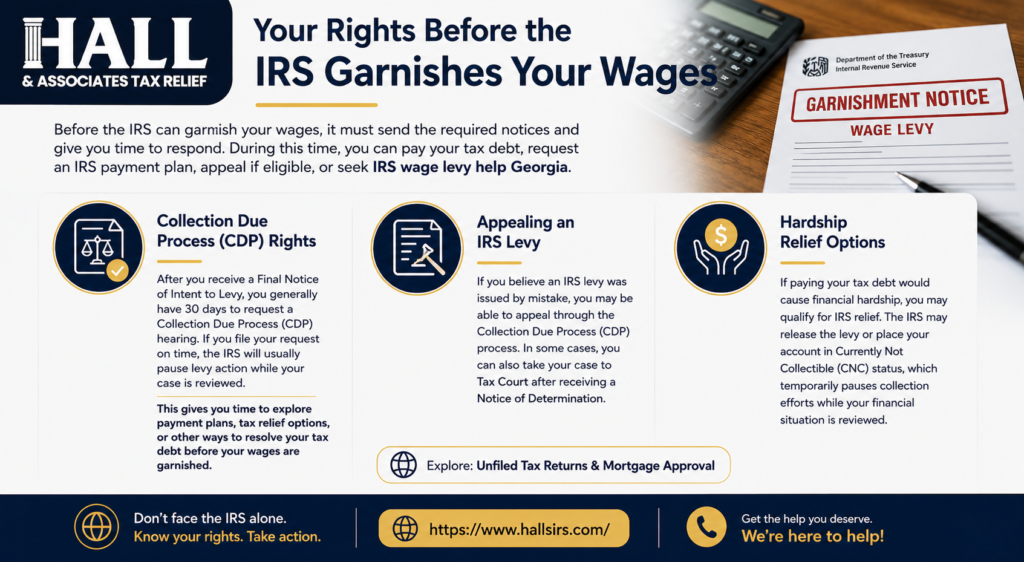
Before the IRS can garnish your wages, it must send the required notices and give you time to respond. During this time, you can pay your tax debt, request an IRS payment plan, appeal if eligible, or seek IRS wage levy help Georgia.
Collection Due Process (CDP) Rights
After you receive a Final Notice of Intent to Levy, you generally have 30 days to request a Collection Due Process (CDP) hearing. If you file your request on time, the IRS will usually pause levy action while your case is reviewed.
This gives you time to explore payment plans, tax relief options, or other ways to resolve your tax debt before your wages are garnished.
Appealing an IRS Levy
If you believe an IRS levy was issued by mistake, you may be able to appeal through the Collection Due Process (CDP) process. In some cases, you can also take your case to Tax Court after receiving a Notice of Determination.
Hardship Relief Options
If paying your tax debt would cause serious financial hardship, you may qualify for IRS relief. In some cases, the IRS may release your wage levy or place your account in Currently Not Collectible (CNC) status, which temporarily pauses collection while your financial situation improves.
Explore: Unfiled Tax Returns & Mortgage Approval
How to Stop an IRS Wage Garnishment Quickly
If you need to stop wage levy 2026, you may have several options:
- Set up an IRS installment agreement with affordable monthly payments.
- Request Currently Not Collectible (CNC) status if you can’t afford to pay.
- Apply for an Offer in Compromise if you qualify to settle your tax debt for less.
- Request a levy release if the garnishment is causing financial hardship.
Getting IRS wage levy help Georgia as early as possible can give you more options and improve your chances of protecting your paycheck.
Why Acting Early Saves Money
Taking action early can help reduce penalties and interest before they continue to grow. It may also help you avoid a Georgia IRS wage levy and give you more options to resolve your tax debt before collection actions become more serious.
Interest and Penalties Continue to Grow
Interest and penalties continue to build until your tax debt is fully paid. The longer you wait, the more you may owe. Taking action early can help lower your total balance and reduce the risk of a Georgia IRS wage levy.
Prevent Additional Collection Actions
A wage garnishment is not the only action the IRS can take. If your tax debt remains unpaid, the IRS may also levy your bank account or file a federal tax lien. These actions can affect your finances, make it harder to access your money, and create additional financial stress.
Special Considerations for Georgia Taxpayers
Georgia taxpayers may face both federal and state tax collection actions. If you owe federal taxes, responding quickly can help you avoid a Georgia IRS wage levy and protect your income.
Federal vs. Georgia Collection Actions
If you owe federal taxes, the IRS can collect the money by placing a wage levy on your paycheck. If you owe state taxes, the Georgia Department of Revenue also has the authority to take collection action. In both cases, the agency must first send you the required notices before taking money from your wages.
With increased tax enforcement in 2026, it is more important than ever to respond to IRS or Georgia tax notices early to avoid wage levies and other collection actions.
Coordinating State and IRS Tax Issues
If you owe both federal and state taxes, it’s important to address both debts. Paying or resolving only one balance may not stop collection action from the other agency. A coordinated plan can help you manage both tax obligations and reduce the risk of additional enforcement.
Explore: 7 IRS Audit Red Flags for 2026
What Georgia Taxpayers Are Currently Seeing From Other Firms
Many Georgia taxpayers are seeing tax relief companies advertise guaranteed settlements, fast debt reduction, and low-cost solutions. While some firms provide legitimate help, it’s important to verify their claims and choose a provider that offers honest, personalized guidance based on your specific tax situation
How Hall and Associates Tax Relief Helps Stop Wage Garnishments
If you’re facing an IRS wage garnishment, Hall and Associates Tax Relief can help you understand your IRS notices, review your tax situation, and explain the relief options available. Their team works directly with the IRS to negotiate payment solutions, request levy releases when appropriate, and help you resolve your tax debt as quickly as possible.
Immediate Levy Protection
Our team works quickly to help stop IRS collection actions. When appropriate, we can request a temporary collection hold or file a Collection Due Process (CDP) hearing request, which may pause collection efforts while your case is reviewed and help prevent or remove an IRS wage levy.
Affordable Payment Options
We help you learn about IRS payment plan options, including installment agreements, Currently Not Collectible (CNC) status, and Offer in Compromise programs when appropriate. We work to find a solution that fits your financial situation and helps resolve your tax debt.
Long-Term Tax Relief
Stopping a wage levy is only the beginning. Hall and Associates Tax Relief helps Georgia taxpayers stay on track, avoid future collection actions, and explore tax relief solutions that fit their financial circumstances.
Conclusion
The IRS wage garnishments increase 2026 Georgia is impacting more taxpayers as IRS collection efforts continue to expand. Understanding your rights and available relief options can help you respond with confidence and reduce the risk of a Georgia IRS wage levy.
If you’re facing an IRS wage levy, Hall and Associates Tax Relief can help. Request immediate IRS levy assistance to review your options, or schedule a confidential consultation to take the next step toward resolving your tax debt.
FAQs
Why are IRS wage garnishments increasing in Georgia during 2026?
The IRS wage garnishments increase 2026 Georgia trend is driven by faster, more automated IRS collection systems, the return of normal notice cycles after pandemic delays, and higher incomes in Georgia metro areas that increase tax exposure.
How much of my paycheck can the IRS garnish?
Unlike private creditors, limited to 25%, the IRS uses an exempt-amount table based on filing status and dependents. Depending on your situation, a Georgia IRS wage levy can take a large portion of your paycheck, sometimes up to 50% or more of take-home pay.
Can I stop an IRS wage garnishment after it starts?
Yes. You can stop a wage garnishment through an installment agreement, Currently Not Collectible (CNC) status, an Offer in Compromise, or a proven financial hardship request. These options can help stop a Georgia IRS wage levy even after it begins.
Will setting up an IRS payment plan stop a wage levy?
In most cases, yes. An approved installment agreement usually stops enforcement actions, including wage garnishment, as long as you stay current with payments and remain compliant.
Can financial hardship stop an IRS garnishment?
Yes. If the garnishment prevents you from covering basic living expenses, you may qualify for a levy release or Currently Not Collectible (CNC) status under IRS wage levy help Georgia options.
How long does an IRS wage garnishment last?
An IRS wage garnishment continues each pay period until the debt is fully paid, a resolution is approved, or the 10-year Collection Statute Expiration Date ends.
What happens if I ignore IRS levy notices?
Ignoring CP14, CP501, CP503, or CP504 notices moves your case closer to a Final Notice of Intent to Levy. After that, you only have 30 days to act before a Georgia IRS wage levy can begin.
Can the IRS garnish wages without going to court?
Yes. The IRS does not need a court judgment. Once required notices are sent and deadlines pass, it can issue a levy administratively.
Can I appeal an IRS wage levy?
Yes. You can request a Collection Due Process hearing within 30 days of the Final Notice. If needed, you may also appeal to Tax Court after the decision.
When should I hire a tax professional for an IRS wage garnishment?
You should act immediately after receiving a Final Notice of Intent to Levy, or as soon as a garnishment starts. Getting IRS wage levy help Georgia early gives you more options, including collection holds, appeals, and payment plans, before wages are further reduced.